
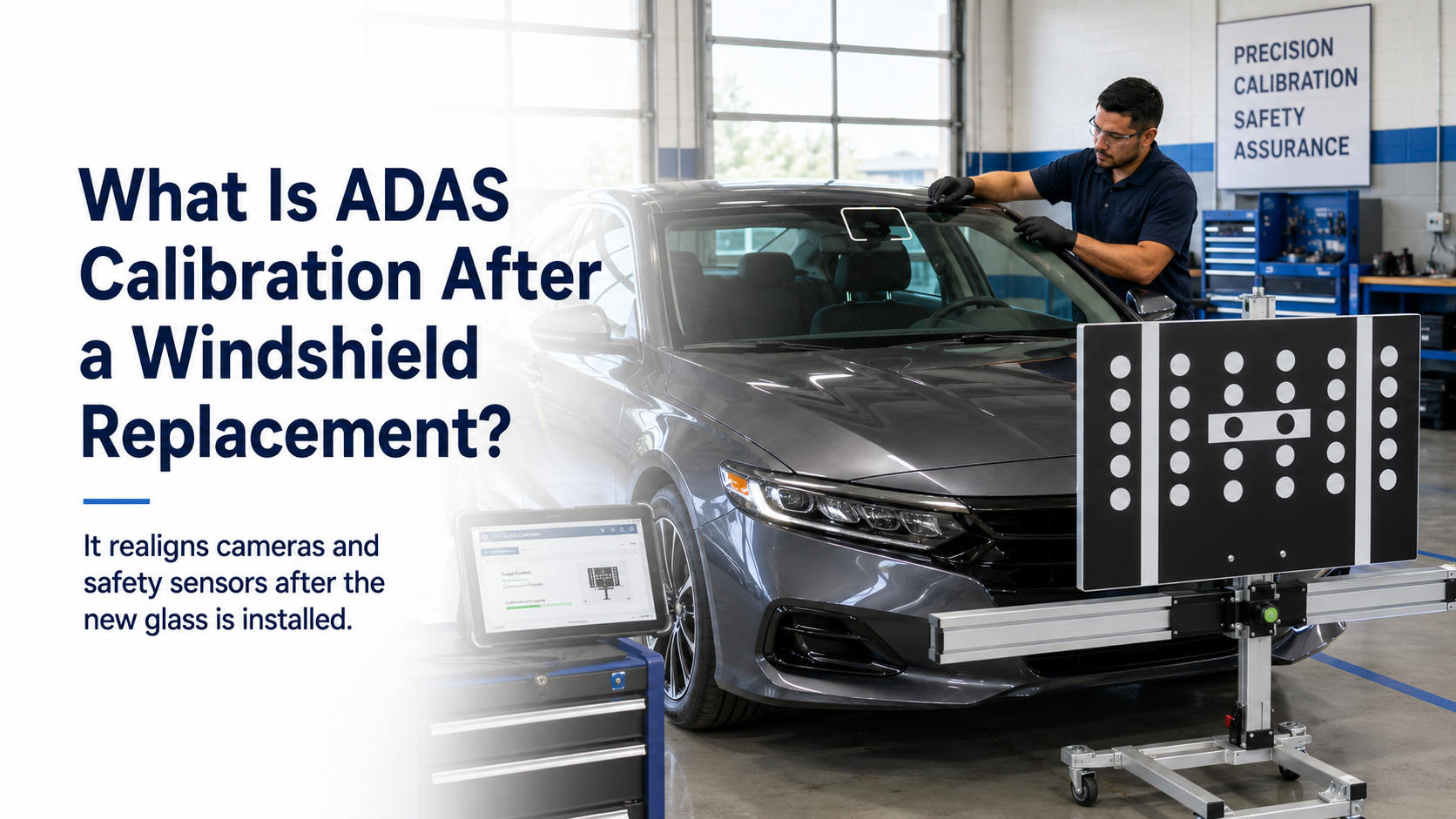
ADAS calibration is the process of realigning your vehicle’s safety cameras and sensors after a windshield replacement so that features like lane-keeping assist and automatic emergency braking read the road accurately again. Because the forward-facing camera that powers these systems is mounted to the windshield, replacing the glass shifts it out of alignment, and recalibration restores it to the manufacturer’s exact specifications. Most vehicles built from 2018 onward need this step, and at Jacob’s Low Price Auto Glass in Dallas we make sure it’s part of a properly completed job.
If your glass technician or dealer mentioned calibration and you weren’t sure what they meant, this is ADAS windshield calibration explained in plain terms: what it is, why it’s required, the difference between static and dynamic calibration, how long it takes, and whether insurance covers it. We’ve served Dallas, Richardson, and Lewisville since 2000, and modern vehicles have made calibration a routine part of doing a windshield replacement right.
The key takeaway up front: a windshield is no longer just glass. On newer vehicles it’s a mounting point for safety technology, and that technology only works when it’s aligned correctly.
ADAS Calibration Realigns Your Vehicle’s Safety Cameras After Glass Work
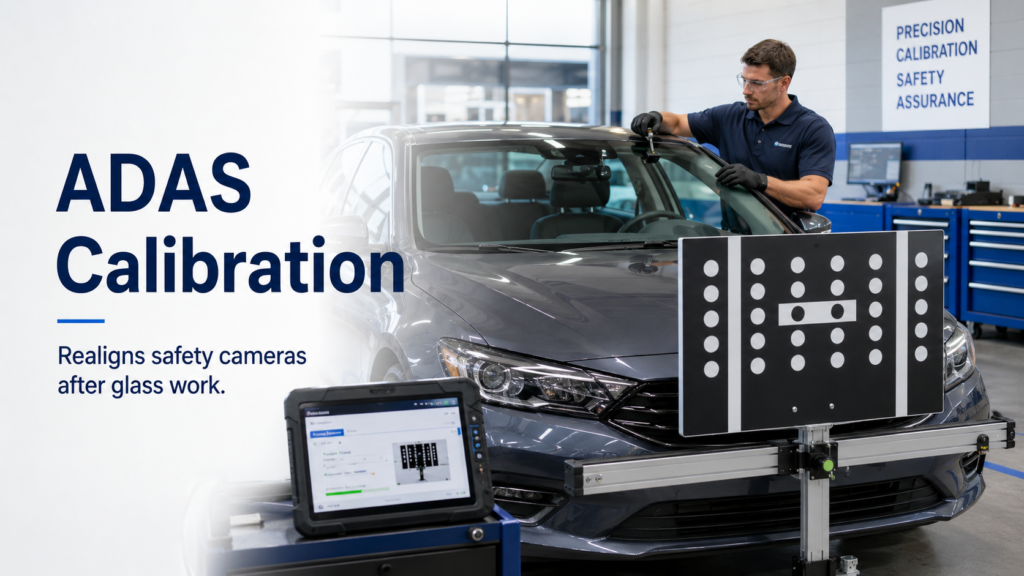
ADAS stands for Advanced Driver Assistance Systems, the suite of safety features that help monitor the road and assist the driver. These systems depend on a forward-facing camera, usually mounted near the rearview mirror on the windshield, along with other sensors that must be precisely aligned to read the environment correctly.
Calibration is what restores that precise alignment. The systems it supports commonly include:
- Lane departure warning and lane-keeping assist, which track lane markings.
- Automatic emergency braking, which detects obstacles and can brake for you.
- Adaptive cruise control, which maintains a safe following distance.
- Forward collision warning, which alerts you to an impending impact.
- Traffic sign recognition, which reads posted signs.
When these systems are properly calibrated, they read the road accurately and respond when you need them. When they’re not, they can’t be trusted to work as designed, which is the whole reason calibration matters after glass work.
Replacing the Windshield Shifts the Camera, So Recalibration Is Required
Recalibration is required after a windshield replacement because even a tiny shift in the camera’s position changes how it sees the road. The camera is aimed at extremely precise angles, so removing the old glass and installing new glass, even perfectly, moves the camera just enough to throw off its readings until it’s realigned.
Windshield replacement is the most common trigger, but it isn’t the only one. ADAS recalibration may also be needed after:
- A camera or radar sensor is disconnected.
- Suspension work or a ride-height change.
- A wheel alignment.
- A collision or any impact affecting the sensors.
- A related software update or fault code.
In other words, anything that moves or disturbs the cameras and sensors can require recalibration. After a windshield replacement specifically, it’s a standard part of finishing the job on a vehicle equipped with these systems.
What’s the Difference Between Static and Dynamic Calibration?
The main difference is that static calibration happens in a controlled shop using targets, while dynamic calibration happens on the road during a test drive. Some vehicles need one, some need the other, and some need both, which is called dual calibration. The exact requirement depends on your vehicle’s make, model, and year, which a technician confirms using your VIN.
| Calibration Type | Where It Happens | How It Works |
|---|---|---|
| Static | In a controlled shop | The stationary vehicle faces specialized target boards placed at precise distances, and diagnostic software realigns the camera to factory specs. |
| Dynamic | On the road | The vehicle is driven at set speeds on well-marked roads in clear conditions, and the system recalibrates itself using real-world lane lines and signs. |
| Dual (both) | Shop, then road | Static calibration is performed first, then dynamic calibration confirms alignment. Common on newer vehicles with multiple safety systems. |
Static calibration needs specific lighting, spacing, and floor conditions to be done correctly, which is why it happens indoors. Dynamic calibration needs clear weather and good lane markings. A quality shop knows which your vehicle requires and has the right setup to complete it.
Do I Really Need Calibration, or Can I Skip It?
If your vehicle has ADAS features, calibration is not optional after a windshield replacement. Your car may still be drivable, but you should not rely on features like lane-keeping assist or automatic emergency braking until calibration is complete, because an uncalibrated system can fail to respond, respond late, or give inaccurate warnings.
A few points clear up common confusion:
- Both OEM and aftermarket glass require calibration. The type of glass doesn’t remove the need to realign the camera.
- The car is drivable, but the safety features aren’t reliable until the system passes calibration.
- Skipping it defeats the purpose of the technology, since a misaligned camera can misjudge distances and lane positions.
Put simply, the systems that are supposed to help prevent a collision can only do their job when they’re aimed correctly. That’s why calibration is treated as part of the replacement, not an optional add-on.
Calibration Adds Time and Cost, but Insurance Often Covers It
ADAS calibration adds time and cost to a windshield replacement because it’s a separate, precise procedure, but it’s frequently covered by insurance. Static calibration typically takes about one to two hours, and dynamic or more complex jobs can take longer, though scheduling calibration together with the replacement often allows same-day completion.
Here’s what to expect:
- Time: Roughly one to two hours for static calibration, added to the install and cure time.
- Cost: Calibration generally adds a few hundred dollars, with luxury and multi-sensor vehicles on the higher end.
- Insurance: Most comprehensive auto policies cover ADAS calibration as part of a windshield replacement claim, and Jacob’s works with all major insurance companies to keep your claim smooth.
While it does add to the bottom line, calibration protects safety systems you’ve already paid for as part of your vehicle. Confirming coverage with your insurer ahead of time takes the guesswork out of the cost.
Jacob’s Low Price Auto Glass Makes Sure Your Replacement Is Done Right in Dallas
Jacob’s Low Price Auto Glass has kept Dallas drivers safe with proper windshield replacements since 2000, and that means making sure your vehicle’s safety systems are addressed, not overlooked. Located south of downtown on S Central Expy, our experienced, highly trained technicians use the latest techniques and tools to complete your replacement correctly the first time.
Here’s what you can count on with us:
- Honest guidance on whether your specific make, model, and year requires calibration after a replacement.
- Factory-matched glass that preserves your antennas, defogger, and other electronics, with everything connected and tested.
- Same-day service when your glass is in our large in-shop inventory, plus mobile service across Dallas, Richardson, and Lewisville.
- Insurance help with all major companies, often for less than your deductible.
- A lifetime warranty on our auto glass and windshield installation against water and air leakage.
If you’re not sure whether your vehicle needs calibration, just give us a call with your make and model and we’ll walk you through it.
Frequently Asked Questions About ADAS Calibration
How do I know if my vehicle needs ADAS calibration?
If your vehicle was built in 2018 or later and has features like lane-keeping assist, adaptive cruise control, or automatic emergency braking, it very likely needs calibration after a windshield replacement. A technician can confirm the exact requirement using your VIN, since the need and the calibration type depend on your specific make, model, and year.
How long does ADAS calibration take?
Static calibration typically takes about one to two hours, and dynamic or more complex calibrations can take longer. When you schedule calibration together with your windshield replacement, same-day completion is often possible, though you’ll want to plan for the added time on top of the install.
Can I drive my car before calibration is done?
Your vehicle is generally drivable before calibration, but you should not rely on ADAS features like lane-keeping assist or automatic emergency braking until it’s complete. Until the system is recalibrated, those features may not function correctly or may give inaccurate alerts, so drive as if they aren’t active.
Does aftermarket glass need calibration too?
Yes. Both OEM and aftermarket windshields require calibration after replacement, because the issue is the camera’s position, not the brand of glass. Any time the windshield is replaced on an ADAS-equipped vehicle, the camera must be realigned regardless of which glass is installed.
Will my insurance pay for ADAS calibration?
In most cases, yes. Most comprehensive auto insurance policies cover ADAS calibration as part of a windshield replacement claim, since it’s a necessary safety step. Jacob’s works with all major insurance companies, and confirming coverage with your insurer beforehand removes any surprise on cost.
The Bottom Line on ADAS Calibration After a Windshield Replacement
ADAS calibration realigns the safety cameras mounted to your windshield so your driver-assistance features work accurately after the glass is replaced. On most vehicles from 2018 onward it’s a required, non-optional step, done either statically in the shop, dynamically on the road, or both, and it’s frequently covered by insurance.
When you want a windshield replacement done correctly, with your safety systems properly handled, the team at Jacob’s Low Price Auto Glass is ready to help. Call us with your make and model for a free quote, and we’ll make sure your replacement and any calibration your vehicle needs are taken care of right.